Trustpilot - Rated Excellent
 In-house Design & Print
 Express Production Options
 Instant Credit for Businesses
 Newsletter


Compact product-led booth, 1967
A late-1960s Festo stand already shows the move towards compact framed presentation, product boards and lightweight display surfaces rather than a heavy built environment.
Festo 1967 image source - history 14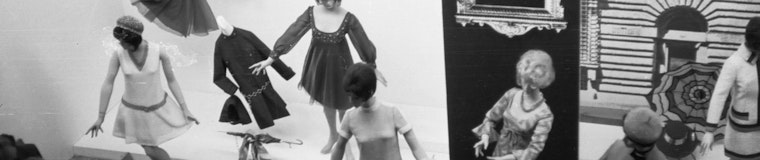
Portable exhibition systems made professional displays easier to move, quicker to install and practical for smaller teams. Folding panels and pop-up frames reduced the need for heavy custom builds.
The modular systems of the 1960s and 1970s made reuse easier, but many exhibition builds still depended on substantial frames, rigid panels and specialist labour. Portable displays pushed the idea further.
The goal was simple: reduce weight, reduce setup time and reduce the number of people needed to get a professional display ready.
EXHIBITOR Magazine's history of portable/modular exhibits says that when the first pop-up displays appeared in the mid-1970s, the other main portable option was the folding panel system. These were hinged frames containing rigid graphic panels. They were easy to unfold and reconfigure, but their heavier materials increased shipping and drayage costs.
Portable display development therefore became a constant trade-off between visual impact, weight, setup time and flexibility.
A late-1960s Festo stand already shows the move towards compact framed presentation, product boards and lightweight display surfaces rather than a heavy built environment.
Festo 1967 image source - history 14This international fair display shows the visual logic that portable systems would refine: defined panels, controlled graphics and a smaller physical footprint that can be moved and reused.
1966 international fair display source - history 14As covered in the previous chapter, Ted Zeigler launched the Instand self-locking pop-up display in 1975. EXHIBITOR describes the original system as an aluminium frame with cross-bracing that expanded and locked into position without conventional fasteners.
Flexible graphic panels attached to the frame, while lights and shelves travelled separately. The whole back wall could pack into a cylindrical case.
That was a major practical change. Instead of transporting a collection of large rigid wall sections, an exhibitor could carry a compact expanding frame and lightweight graphics.
Nomadic Display still describes Instand as the world's first self-locking pop-up system and notes that the design could be set up without tools.
A custom exhibition stand can deliver excellent visual impact, but it normally comes with design, construction, transport, storage and installation costs.
Portable systems reduce those barriers. A smaller business can own a display, take it to several events and install it with its own team.
That matters because it broadens participation in exhibitions. A company no longer needs a major construction budget just to create a recognisable branded backdrop.
Portable displays also make smaller event formats more practical: regional shows, conferences, recruitment fairs, dealer meetings and roadshows can use professional graphics without the logistics of a large bespoke stand.
The exhibition industry is becoming more scalable.
By the late 1970s and 1980s, portable exhibit manufacturers increasingly designed around shipping and setup from the start. Systems were promoted on the basis that they could fold, collapse or pack into cases and then be rebuilt at the venue with minimal labour.
That is an important shift. The transport case is no longer an afterthought. Logistics, setup and display are treated as one product system.
Modern portable exhibition kits still follow the same principle. Cases become counters, frames collapse into bags and graphics roll or fold for transport.
Good portable display design starts by asking what happens before and after the exhibition as well as what the visitor sees during it.
The first portable displays solved logistics problems, but they were not as flexible as modern systems.
EXHIBITOR notes that early pop-ups were largely limited to a 10-foot back wall, with individual square graphic panels attached to the frame. Shelving and lighting existed, but design options were relatively restricted.
Folding panel systems offered more freedom to change shape, but their rigid construction made them heavier.
This explains what happened next. Through the 1980s and 1990s, manufacturers kept trying to combine the convenience of portable hardware with the visual flexibility of a custom stand.
That evolution eventually produced magnetic panels, rollable fabric graphics, integrated shelving, backlit elements and increasingly sophisticated portable systems.
Portable systems change the practical expectations of an exhibition stand:
One or two people can install it.
The stand can travel in compact cases.
Setup requires fewer tools and less specialist labour.
Graphics can be reused or replaced separately from the frame.
Smaller businesses can create professional exhibition spaces.
Regional events and roadshows become easier to support.
The stand is no longer tied to one venue or one event.
It can travel with the exhibitor.
That portability sets the stage for one of the most recognisable display products of the next era: the roller banner.
The phrase 'portable displays' covers several different systems. Folding panel exhibits existed before the self-locking pop-up. Ted Zeigler's documented 1975 milestone applies specifically to the self-locking pop-up display, not to every portable exhibition product.
The two period images used here are reused from the previous chapter because they are already cleared and stored in the Display Wizard media library. They illustrate the panel-led, compact display approach that portable systems developed further in the 1970s and 1980s.
Retractable graphics create a new portable display format.
Explore the roller bannerDigital print transforms the speed and scale of graphics.
Explore large-format printingScreens add motion, video and digital content to stands.
Explore screens entering the standInteractive technology turns visitors into active participants.
Explore the experience eraExhibitions become more flexible, connected and reusable.
Explore how exhibitions adaptedThe earliest visual communication on shared physical surfaces.
Explore cave artPermanent communities create new spaces for exchange and display.
Explore early settlementsAgoras and forums bring sellers, buyers and ideas together.
Explore ancient marketplaces