Trustpilot - Rated Excellent
 In-house Design & Print
 Express Production Options
 Instant Credit for Businesses
 Newsletter


2010s: The Experience Era
Interactive technology turns visitors into active participants.
Explore the experience era
By the 2000s, exhibition stands were no longer limited to printed backdrops and brochure tables. Flat-panel screens, digital presentations and increasingly sophisticated graphics turned the stand into a multimedia sales environment.
During the 2000s, exhibition design changed again. In the 1990s, large-format digital printing had made exhibition graphics bigger, more colourful and easier to update. The next step was adding moving content to the stand.
LCD and plasma displays became progressively thinner and more practical for commercial environments. Exhibitors could now run product videos, presentation loops, demonstrations, customer case studies and animated brand content from the same stand that still carried printed graphics.
This did not replace print. Instead, the two media started working together. Printed backwalls created the large visual identity; screens added motion, information and changing content.
The exhibition stand was becoming a multimedia sales environment rather than a static backdrop.
A printed panel normally communicates the same message for the entire event. A screen can change every few seconds.
That meant one display area could now support several jobs:
show a product demonstration;
play a brand film;
cycle through customer case studies;
support a live presentation;
display technical information;
attract attention through movement;
change messaging for different audiences during the day.
This flexibility became particularly useful for products that were difficult to bring onto the stand physically. Software, complex machinery, services and technical systems could all be demonstrated through video or digital presentation.
The physical stand no longer had to contain every part of the sales story.
A typical professional exhibition setup in the 2000s increasingly combined several layers:
a printed backdrop or pop-up display;
portable banner stands;
counters and literature holders;
large-format photographic graphics;
LCD or plasma screens;
laptops, DVD players or media players feeding digital content.
The important change is not simply that televisions appeared on exhibition stands. It is that exhibitors began planning physical graphics and digital content as one communication system.
This is the direct ancestor of today's multimedia stands, where printed fabric, LED lightboxes, touchscreens, video walls and interactive displays all work together.
Display Wizard becomes part of this history in 2004. Companies House records that the business now known as Display Wizard Limited was incorporated on 24 February 2004 as Wizard Display & Exhibition Solutions Limited. The company adopted the Display Wizard Limited name later that year.
Display Wizard's current About Us page also records the business as having been founded in 2004.
An archive screenshot supplied by Display Wizard from that year shows an early website offering products including Pop Up Display, Banner Stands, Display Systems, Panel Kits, Display Cases, Outdoor Displays, Exhibition Trailers, Literature Dispensers, Portable Furniture and Exhibition Stands.
The homepage carried the line:
This is deliberately only one milestone within the wider story. Display Wizard entered an exhibition market that was already becoming more portable, more digitally printed and increasingly influenced by screen-based presentation.
View Display Wizard's current About Us page
Companies House: Display Wizard Limited, company number 05054229
Three pieces of surviving company material help document Display Wizard's early development:
The original homepage presents the company as Wizard Exhibition & Display Solutions and emphasises portable exhibition products, large-format display and UK delivery. It also demonstrates how early exhibition suppliers were beginning to use the web as part of the sales process rather than relying entirely on printed catalogues and telephone enquiries.
A surviving 2007 promotional image uses a theatrical 'wizard' character in front of international flags. It reflects the playful brand identity that developed around the Display Wizard name during the company's early years.
By 2008, an archived logo uses the wording Display Wizard International Exhibition Services, with the star-and-wand motif becoming a much more prominent part of the visual identity.
These archive items will sit alongside the wider industry story rather than turning this chapter into a company history.
The stand itself was becoming digital, but so was the way exhibition products were bought.
By the 2000s, company websites were increasingly becoming searchable product catalogues. Buyers could research banner stands, pop-up systems and accessories before ever speaking to a salesperson. Artwork could be created digitally, emailed to the supplier and sent directly into digital print production.
This connected several technologies that had developed independently:
desktop design software created the artwork;
the internet moved the files and product information;
large-format printers produced the graphics;
portable display hardware carried them to the event;
screens added moving digital content once the stand was installed.
The exhibition supply chain was becoming digital from beginning to end.
One reason screens became so useful is that many modern products cannot be understood from a static photograph.
Software can be demonstrated live. Machinery can be shown working without transporting the machine. Architectural projects can be visualised. Customer testimonials can play automatically. Product ranges can rotate through a slideshow instead of taking up physical floor space.
The stand becomes capable of communicating far more information without necessarily becoming larger.
That shift would accelerate dramatically in the following decade as touchscreens, tablets, social media, projection, LED technology and increasingly affordable digital signage became commonplace.
The decade connects the physical and digital exhibition worlds:
Screens become a normal part of professional stands.
Video and animation introduce movement to the display.
Printed graphics and digital presentation begin working together.
The web becomes part of how exhibition products are researched and bought.
Digital artwork flows directly into large-format print production.
Portable hardware continues becoming easier to buy and deploy.
The stand is no longer simply something visitors look at.
It can now show, explain and demonstrate.
The next step is to make the visitor part of the experience.
Companies House: Display Wizard Limited - company number 05054229
Display Wizard archive: website homepage screenshot, 2004
Display Wizard archive: promotional advert, 2007
Display Wizard archive: Display Wizard International Exhibition Services logo, 2008
Companies House records the incorporation date as 24 February 2004 and shows the original company name as Wizard Display & Exhibition Solutions Limited, changed to Display Wizard Limited on 18 October 2004. The Display Wizard About Us page independently states that the company was founded in 2004.
The three company archive images referenced above were supplied directly by Display Wizard for this history project. They are treated as supporting company archive material rather than evidence for wider industry developments.
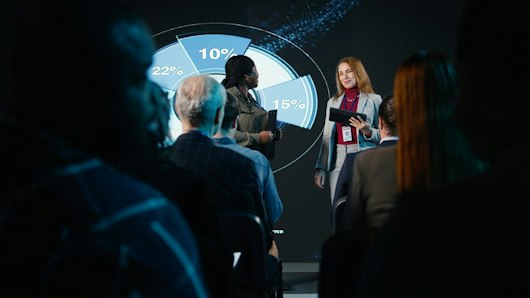
The current featured image is an illustrative multimedia-display image already held in the Display Wizard CMS. It is not presented as a photograph from the 2000s. The supplied 2004, 2007 and 2008 archive images should replace or supplement it once those private files are uploaded into the Dato media library.
Interactive technology turns visitors into active participants.
Explore the experience eraExhibitions become more flexible, connected and reusable.
Explore how exhibitions adaptedThe earliest visual communication on shared physical surfaces.
Explore cave artPermanent communities create new spaces for exchange and display.
Explore early settlementsAgoras and forums bring sellers, buyers and ideas together.
Explore ancient marketplacesRecurring fairs begin to resemble organised trade events.
Explore medieval trade fairsRetailers discover the selling power of street-facing displays.
Explore shop window displaysManufacturers publicly demonstrate industrial capability.
Explore the 1798 industrial exhibition