Trustpilot - Rated Excellent
 In-house Design & Print
 Express Production Options
 Instant Credit for Businesses
 Newsletter


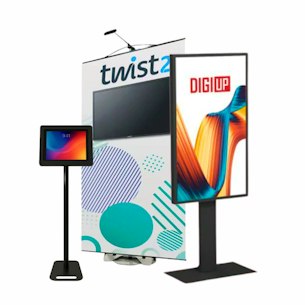
2000s: Screens Enter the Stand
Screens add motion, video and digital content to stands.
Explore screens entering the stand
Portable display hardware was getting easier to move. At the same time, large-format digital printing was transforming what exhibitors could put onto those displays: bigger graphics, more colour and faster turnaround.
For much of the 20th century, large exhibition graphics relied on processes such as signwriting, screen printing, cut vinyl, photographic enlargement and other labour-intensive production methods. These techniques could produce excellent results, but changing artwork or producing short runs was comparatively slow and expensive.
During the 1990s, wide-format inkjet technology became increasingly practical. Digital artwork could be sent directly from a computer to a printer capable of producing output measured in feet rather than inches.
That did not immediately replace every traditional process, and early large-format printers were often designed primarily for CAD, proofing or specialist graphics. But the direction was clear: large graphics were becoming digital files rather than hand-built production jobs.
HP's own DesignJet history dates the launch of the HP DesignJet 600 to 1991 and describes it as the world's first large-format inkjet plotter. The early DesignJet range was aimed heavily at architecture, engineering and technical drawing rather than exhibition graphics, but it helped establish inkjet as a credible technology for wide media.
Colour followed quickly. HP's 1994 technical journal describes the DesignJet 650C as its first large-format colour thermal inkjet plotter, opening applications that monochrome plotters could not support.
The significance for the display industry is indirect but important: the same basic digital-printing logic that transformed technical drawing was becoming capable of producing increasingly sophisticated colour graphics.
Printer manufacturers increasingly targeted full-colour graphics rather than technical line drawings. Mimaki's product-development history records the JV-1300 in 1996 as a full-colour inkjet printer using six-colour pigment ink, followed by the JV2 series and a large-format full-colour JV2-180 in 1999.
Six-colour systems helped improve tonal range and photographic reproduction compared with simpler four-colour output. Better RIP software also made it easier to convert design files into printable raster data and manage larger graphics.
The result was a major practical change for exhibitors: photography, gradients, detailed product imagery and complex branded backgrounds could be produced at exhibition scale without requiring a different analogue process for every design.
Roland DG records another useful milestone in 1997 with the CAMMJET CJ-70, described by the company as the world's first wide-format inkjet printer/cutter.
Instead of treating printed graphics and contour-cut vinyl as completely separate production steps, one machine could print a design and then cut around it.
That matters for signs, labels, decals and display graphics because digital production becomes more integrated. A graphic can be created on screen, printed at large scale and cut accurately from the same digital artwork.
Roland followed with the Hi-Fi JET FJ-50 in 1998, which the company describes as the first six-colour 1440-dpi wide-format inkjet printer.
This is where digital wide-format printing fits particularly well with exhibitions.
A trade-show graphic is rarely required in thousands of identical copies. An exhibitor might need one backdrop, two side panels, a handful of posters or a set of graphics tailored to one campaign. Traditional mass-production printing methods are strongest when the same image is repeated many times. Digital printing is strongest when each job can be different.
That makes it easier to:
change campaign artwork between events;
produce one-off exhibition panels;
personalise graphics for different markets;
include photographic product imagery;
correct artwork without remaking screens or plates;
produce replacement graphics without replacing the hardware.
The physical display system and the printed message increasingly become separate assets.
Early digital wide-format output was not perfect. Water-based inks could struggle with weather resistance, media choices were more limited and print speeds were modest by modern standards. Outdoor signage often still needed specialist materials, lamination or other technologies.
These limitations explain the next wave of development. Solvent, eco-solvent and UV-curable ink technologies in the early 2000s would make it much easier to print directly onto durable media for banners, signs, vehicle graphics and outdoor displays.
So the 1990s should be seen as the decade in which the workflow changes fundamentally, even though the technology continues improving rapidly afterwards.
The impact is difficult to overstate:
Full-colour graphics become easier to produce at exhibition scale.
Photography can cover entire display panels.
Short runs become economically practical.
Artwork can change without rebuilding the stand.
Replacement graphics become a viable product category.
Print and cutting increasingly connect directly to digital design files.
Portable hardware had already made the exhibition stand easier to transport.
Digital printing now made the message just as easy to change.
That combination would define exhibition graphics in the 2000s.
Hewlett-Packard Journal, February 1994: large-format colour inkjet development
Image Reports: Wider Still and Wider - history of wide-format printing
Wide-format digital printing did not begin in one single year and early machines served CAD, proofing, photography and signage markets differently. This page focuses on the 1990s period when colour inkjet technology, RIP software and printer/cutter systems became increasingly relevant to commercial display graphics.
The featured plotter photograph dates from 2009 and is licensed CC BY-SA 3.0. It is used only to illustrate the mechanics of roll-fed large-format printing, not as a photograph of a specific 1990s machine.
Screens add motion, video and digital content to stands.
Explore screens entering the standInteractive technology turns visitors into active participants.
Explore the experience eraExhibitions become more flexible, connected and reusable.
Explore how exhibitions adaptedThe earliest visual communication on shared physical surfaces.
Explore cave artPermanent communities create new spaces for exchange and display.
Explore early settlementsAgoras and forums bring sellers, buyers and ideas together.
Explore ancient marketplacesRecurring fairs begin to resemble organised trade events.
Explore medieval trade fairsRetailers discover the selling power of street-facing displays.
Explore shop window displays