Trustpilot - Rated Excellent
 In-house Design & Print
 Express Production Options
 Instant Credit for Businesses
 Newsletter






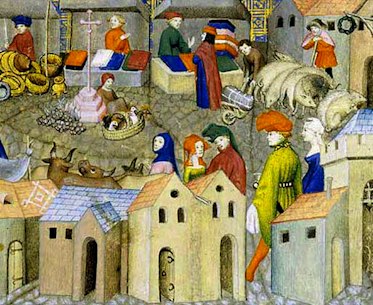
1100s-1300s: Medieval Trade Fairs
Recurring fairs begin to resemble organised trade events.
Explore medieval trade fairs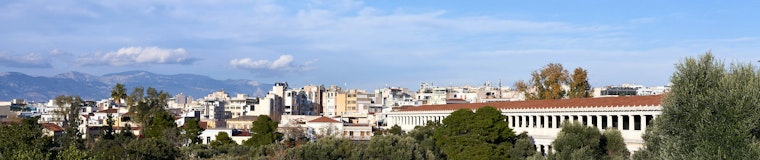
In the Greek agora and later the Roman forum, commerce moved into some of the busiest public spaces in the ancient world. Goods, people and ideas competed for attention in the same place.
By the early first millennium BC, trade was no longer confined to occasional exchange between small communities. In Greek cities, public squares known as agoras developed into places where civic life, politics, religion and commerce overlapped.
The Athenian Agora is a particularly well-documented example. The American School of Classical Studies describes it as the business, political and legal centre of ancient Athens, bringing together citizens, foreigners, merchants, philosophers, litigants and jurors.
That makes it much closer to the later logic of an exhibition or trade show than anything we have seen so far: a concentrated public space where many people gathered and where commercial activity competed for attention alongside everything else happening around it.
The date 600 BC is best treated as a broad marker rather than the moment the marketplace was invented. The Athenian Agora developed over time, with major public buildings appearing through the 6th and 5th centuries BC.
The Greek agora was not simply a row of stalls. It was a shared civic space where commercial activity sat alongside administration, debate, religion and social life.
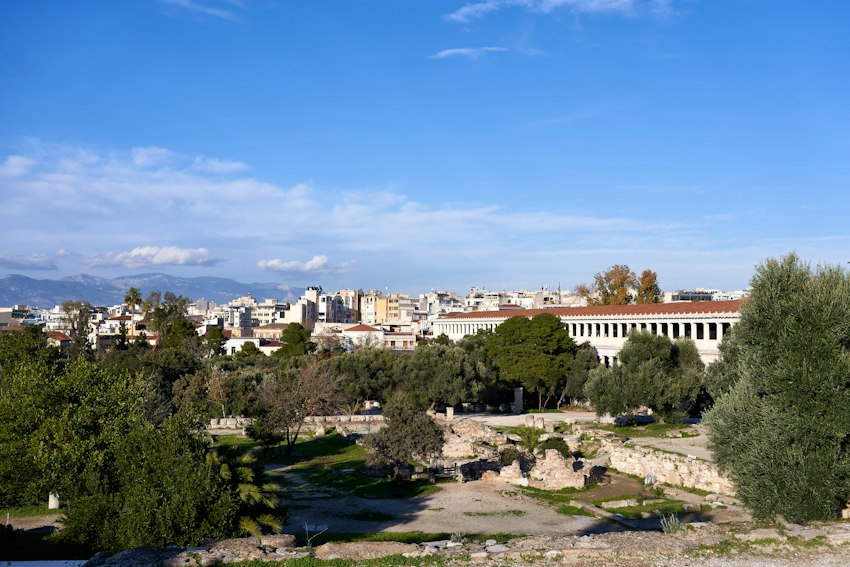
The Athenian Agora eventually included stoas, public buildings, workshops and commercial premises around the open square. The restored Stoa of Attalos shown here is later, dating to the 2nd century BC, but it demonstrates the kind of covered colonnaded architecture that became closely associated with the Agora's commercial environment.
The important display lesson is the concentration of attention. A merchant did not need to create an audience from nothing. The audience was already there.
In modern terms, the location itself generated footfall.
Explore the Athenian Agora excavations
Image: George E. Koronaios / Wikimedia Commons, CC BY-SA 4.0. View the original and licence_in_Ancient_Agora.jpg).
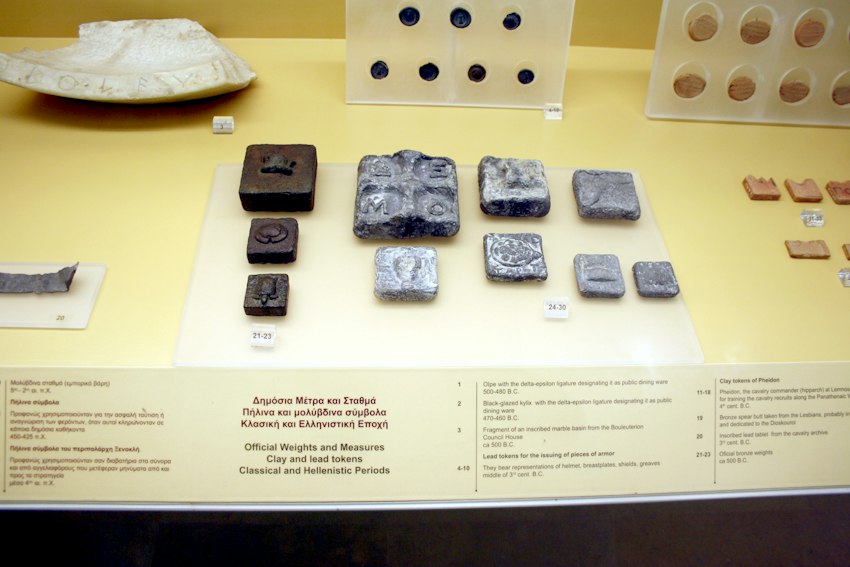
Commerce in a busy marketplace depends on more than having goods available. Buyers need ways to judge quantity, price and value.
Official bronze weights from the Athenian Agora, dating to around the 6th century BC, show that trade was being regulated through standardised measures. Archaeological finds from the Agora also include coins, workshops and evidence for trades ranging from shoemaking and weaving to food selling and luxury goods.
This matters to the history of display because once multiple sellers operate in the same shared space, goods become directly comparable. Presentation, reputation and visibility begin to matter alongside the object itself.
We cannot reconstruct exactly how every seller arranged their stock, but the commercial environment clearly rewarded being noticed and trusted.
Read the American School's overview of commerce in the Agora
Image: Giovanni Dall'Orto / Wikimedia Commons. Commercial reuse permitted with attribution. View the original file and reuse terms.
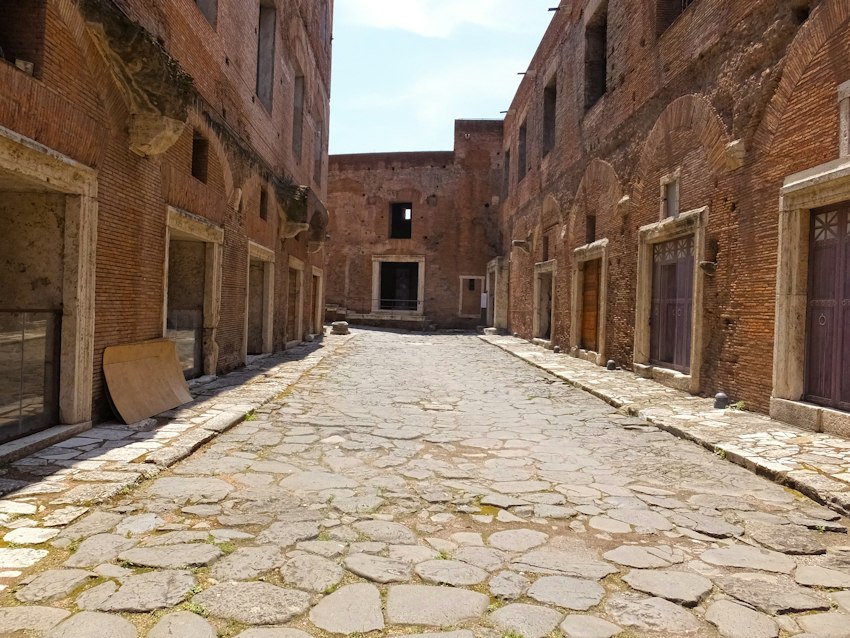
The Romans developed the same basic idea on a much larger urban scale. Forums combined civic, political and commercial functions, while shops known as tabernae were built directly into streets, basilicas, markets and public complexes.
The surviving complex commonly called Trajan's Market in Rome dates to the early 2nd century AD, much later than our 600 BC starting point. It is useful here because it shows how thoroughly commerce had become embedded in permanent architecture.
Via Biberatica is lined with doorways that opened into rooms traditionally interpreted as shops, offices or service spaces. Instead of a temporary gathering of traders, commercial visibility was now designed into the city itself.
That is a major step towards the shopfront, branded premises and exhibition spaces that appear later in our timeline.
Image: Carole Raddato / Wikimedia Commons, CC BY-SA 2.0. View the original and licence.jpg).
The ancient marketplace introduces three ideas that will keep appearing throughout this history:
Footfall: commerce moved to places where large numbers of people already gathered.
Comparison: competing sellers and products could be encountered in the same place.
Visibility: being easy to see and understand became commercially useful.
We should still avoid imagining a modern branded exhibition stand in classical Athens. Signage, merchandising and advertising developed very differently across ancient societies, and much of the physical evidence has not survived.
But the commercial principle is becoming recognisable:
Find a crowd. Show what you have. Give people a reason to choose you.
American School of Classical Studies at Athens: Athenian Agora
Dorothy B. Thompson, An Ancient Shopping Center: The Athenian Agora
Wikimedia Commons: Stoa of Attalos_in_Ancient_Agora.jpg)
The date 600 BC is used as a timeline marker, not as a claim that marketplaces began at that exact moment. The Athenian Agora developed progressively, with major civic building programmes continuing through the 6th and 5th centuries BC.
Recurring fairs begin to resemble organised trade events.
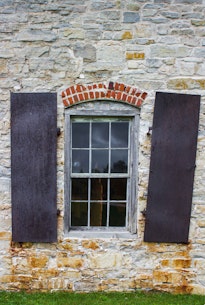
Explore medieval trade fairsRetailers discover the selling power of street-facing displays.
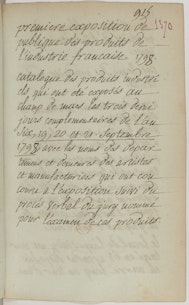
Explore shop window displaysManufacturers publicly demonstrate industrial capability.
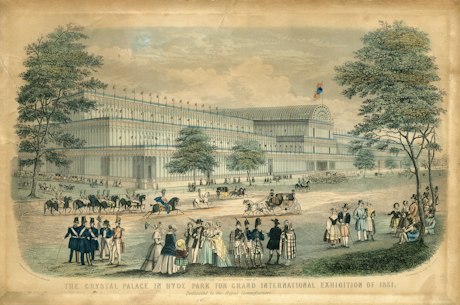
Explore the 1798 industrial exhibitionThe Crystal Palace turns exhibiting into a global spectacle.
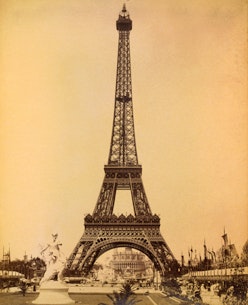
Explore the Great ExhibitionArchitecture itself becomes part of the exhibition experience.
Explore the 1889 Paris ExpositionChicago combines industry, spectacle and visitor entertainment.
Explore the 1893 Chicago fairIndustry-specific shows create the modern trade-show model.
Explore early specialist trade showsBrands turn exhibition spaces into coordinated visual environments.
Explore exhibition branding