Early twentieth-century specialist trade shows

Early 1900s: Specialist Trade Shows Take Shape

A History of Trade Shows

By the early 20th century, exhibitions were increasingly organised around individual industries. Motor cars, electricity, machinery and agriculture now had events where buyers could come specifically to compare the latest products.

From world fairs to industry-specific shows

The great international exhibitions of the 19th century tried to show almost everything: manufacturing, machinery, art, transport, agriculture and national achievements under one event brand.

Around the turn of the 20th century, another format became increasingly important: the specialist exhibition. Instead of attracting the whole world to see every industry, organisers built events around a specific sector and attracted an audience already interested in that subject.

Automobiles provide one of the clearest examples. The official Paris Motor Show traces its origins to 1898, when the Exposition Internationale d'Automobiles was held in the Tuileries Gardens as an event devoted specifically to the new motor car. New York followed with its first automobile show at Madison Square Garden in 1900.

This shift is fundamental to the modern trade-show model: the organiser no longer has to create interest from nothing. The people entering the hall already care about the industry.

The exhibition stand becomes recognisably branded

The audience becomes more valuable because it is more relevant

The New York Auto Show's own history records 69 exhibitors, 160 vehicles and around 48,000 visitors at its first show in 1900. Those visitors were not attending a giant universal exposition containing thousands of unrelated attractions. They were coming specifically to see automobiles.

That changes the economics of exhibiting. A manufacturer can spend money on a stand knowing that almost everyone walking past has at least some interest in the product category.

The same logic spread across other industries. Agriculture had long used specialist fairs, engineering societies organised machinery exhibitions, and new technologies created their own events.

The modern trade show's greatest advantage begins to emerge clearly: put a concentrated group of suppliers in front of a concentrated group of relevant buyers.

Read the New York Auto Show's official history

Products could now be demonstrated, not just displayed

Some industries benefited particularly strongly from the exhibition format because their products were easier to understand when seen working.

Electrical shows are a good example. Smithsonian records that Chicago's annual electrical show opened in 1906, when household electricity was still relatively uncommon in the United States. More than 100,000 people visited its roughly 30,000 square feet of exhibition space during a two-week run.

The shows included working demonstrations of lighting, appliances, machinery and electrical experiments. By 1921, the New York Electrical Show featured more than 90 booths and over 450 appliances.

This is the same principle behind a modern product demo: a brochure can describe technology, but an exhibition lets the visitor see it operate.

Read the Smithsonian history of early electrical shows

Exhibitors start designing for competition

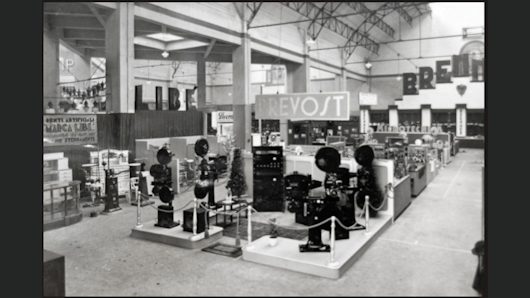
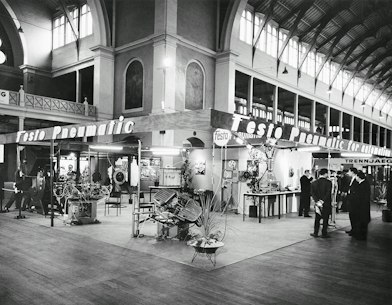
Look closely at early motor-show photographs and another change is obvious. Manufacturers are not merely displaying their products. They are competing visually with the company next door.

Large company names sit above stands. Decorative arches frame products. Cars are placed on platforms or behind rails. Lighting, plants, flags and architectural details distinguish one exhibitor from another.

The exhibition floor is beginning to resemble the modern trade-show environment: every company has a limited area in which to answer the same question.

Why should this visitor stop here rather than at the next stand?

That question drives exhibition design to this day.

Why the early 1900s matter to trade-show history

The specialist exhibition establishes the model that still dominates many B2B and consumer events:

  • One industry or subject brings the audience together.

  • Relevant exhibitors compete side by side.

  • Visitors arrive with existing intent to research, compare or buy.

  • Products can be demonstrated in person.

  • Brand identity becomes part of stand design.

  • New launches and innovations give people a reason to return each year.

  • The event becomes part of the industry's calendar.

The world fair had proved that exhibitions could attract enormous crowds. Specialist shows made the audience more targeted.

For exhibitors, that could be even more valuable.

Sources & further reading

Historical note

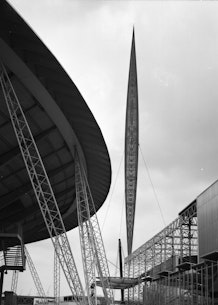
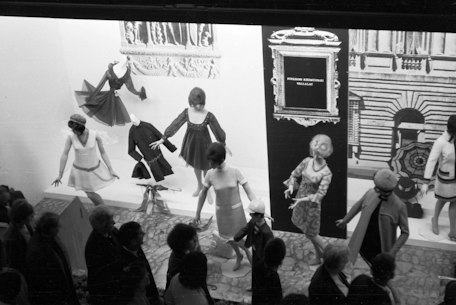
This page uses 'early 1900s' as a broad phase rather than claiming that the trade-show industry began in one particular year. Specialist exhibitions existed before 1900, including agricultural and industrial fairs. What becomes especially clear around this period is the growth of recurring, industry-specific events such as dedicated automobile and electrical shows. The three photographs are by Jules Beau and are marked public domain on Wikimedia Commons.

Explore More History