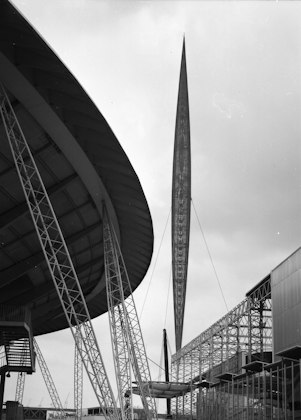
The Skylon at the Festival of Britain on London's South Bank in 1951

1950s: The Exhibition Boom

A History of Trade Shows

After the disruption of the Second World War, exhibitions returned with new confidence. Trade fairs expanded, purpose-built venues grew and stands became increasingly ambitious, professional and expensive.

Exhibitions return with a new sense of purpose

The Second World War had interrupted international exhibitions, repurposed venues and redirected manufacturing towards wartime production. When large public and trade events returned after 1945, they became symbols of reconstruction, industrial recovery and technological optimism.

One of the clearest examples was the Hannover Export Fair of 1947. According to HANNOVER MESSE's official history, roughly 736,000 visitors from 53 countries attended its first 21-day event, generating export contracts worth close to US$32 million.

The event expanded rapidly. By 1950 it had attracted foreign exhibitors from ten countries, and by 1954 the covered exhibition area had grown from around 30,000 square metres in 1947 to 200,000 square metres.

The post-war exhibition was no longer a novelty. It was becoming essential industrial infrastructure.

Read the official HANNOVER MESSE history

Post-war exhibitions become designed experiences

Exhibition sites grow into permanent business infrastructure

The rapid growth of HANNOVER MESSE shows how important exhibitions were becoming to industry. What began in 1947 using a small group of surviving factory halls expanded year by year as new halls were added and international exhibitors returned.

In 1952, Hannover-Langenhagen Airport opened just in time for the fair, making it easier for international visitors to reach the exhibition grounds. HANNOVER MESSE's own history describes the airport as part of the city's effort to connect the event to the wider world.

By the end of the decade, the event was on its way to attracting more than a million visitors annually.

That tells us something important: exhibitions were no longer events that simply rented whatever building was available. Cities were beginning to build transport, accommodation and venue infrastructure around them.

Stand design becomes more elaborate

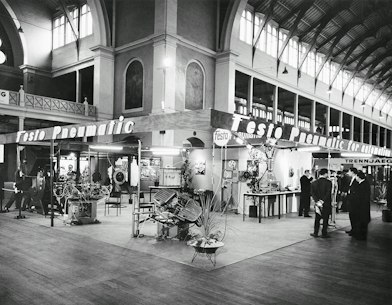
The 1950s exhibition stand often looks much more familiar to a modern exhibitor than anything from the previous century.

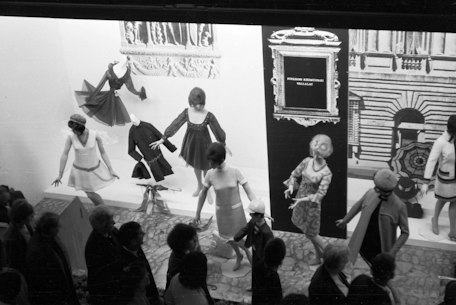
Companies used defined wall systems, counters, illuminated signage, product showcases, meeting furniture and separate areas for demonstrations or conversations. Larger exhibitors could create substantial architectural structures that looked almost like permanent shops or showrooms.

This increased ambition had a commercial cost. Stands required more design work, more materials, more labour and more logistics.

That creates a question that exhibition teams still ask today:

Can we reuse this next year?

The need to balance visual impact with transport, installation and repeat use would become one of the forces driving modular exhibition systems in the following decades.

The Festival of Britain shows how sophisticated display design had become

The Festival of Britain in 1951 was not a conventional trade show, but it is extremely useful for understanding post-war display design.

The National Archives describes the festival as a nationwide celebration of British achievement, with the South Bank site acting as its visual centrepiece. Specialist pavilions covered themes including power and production, transport, science, health and industrial design.

Historic England's records for the Power and Production Pavilion show how the building and exhibition content were designed together. Its displays moved visitors through themes including power, metals, research, machines at work, craftsmen at work, commerce and finished products.

The important change is that display design is now being planned around a visitor journey rather than a collection of independent exhibits.

Explore the National Archives' Festival of Britain collection

Exhibitions become part of normal business planning

As recurring fairs expanded, exhibiting became less exceptional. Manufacturers began treating major trade fairs as regular points in the business calendar: places to launch products, meet distributors, demonstrate machinery and maintain relationships with customers.

That regularity changes how companies think about their stands. If you know you will be exhibiting again next year, the stand is no longer a one-off construction problem. It becomes an asset that needs to be stored, transported, refreshed and reused.

This creates the commercial pressure behind one of the next major developments in our timeline: portable and modular exhibition systems.

Why the 1950s matter to exhibition history

The post-war exhibition boom strengthens several parts of the modern trade-show model:

  • Large permanent exhibition venues become economically important.

  • International attendance returns and grows.

  • Transport infrastructure develops around major events.

  • Stand architecture becomes more ambitious.

  • Visitor journeys and themed displays become more sophisticated.

  • Exhibiting becomes a recurring business activity.

  • Reuse and logistics start to matter almost as much as appearance.

The exhibition stand is getting bigger and better.

The next problem is obvious: how do you make it easier to build, move and use again?

Sources & further reading

Image licensing

The South Bank Exhibition photograph by Ben Brooksbank is licensed CC BY-SA 2.0. The Skylon photograph is licensed CC BY-SA 4.0 by its copyright holder.

Historical note

This page uses the 1950s as a broad post-war exhibition phase. HANNOVER MESSE began in 1947, before the decade itself, because its rapid expansion is one of the clearest examples of the post-war exhibition boom that defined the 1950s.

Explore More History