Trustpilot - Rated Excellent
 In-house Design & Print
 Express Production Options
 Instant Credit for Businesses
 Newsletter


A purpose-built exhibition ground
A historical image of the 1798 exposition on the Champ de Mars. The event was deliberately staged as a public showcase rather than an ordinary market.
1798 exposition grounds image source - history 6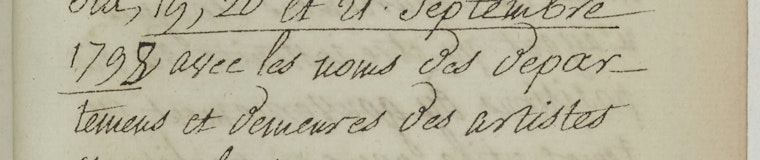
In 1798, France staged a national exhibition dedicated to manufactured products. Makers were no longer simply selling goods. They were publicly demonstrating the strength of industry itself.
In September 1798, the French government staged the Exposition publique des produits de l'industrie française on the Champ de Mars in Paris.
This was not the first time manufactured goods had ever been shown to the public, but it was an important change in scale and purpose. The event was organised as a national showcase of French manufacturing, with producers invited to present their work publicly and a jury appointed to assess the exhibits.
The official catalogue survives, listing the artists and manufacturers who took part and recording the jury's examination of their products. That makes this one of the clearest early ancestors of the formal industrial exhibition.
A historical image of the 1798 exposition on the Champ de Mars. The event was deliberately staged as a public showcase rather than an ordinary market.
1798 exposition grounds image source - history 6A 1798 manuscript transcription associated with the official exhibition catalogue. The surviving record names exhibitors and describes the event itself.
1798 exhibition manuscript page 1 - history 6The official records treat makers and manufacturers as participants in a judged public exhibition, not simply as anonymous sellers in a marketplace.
1798 exhibition manuscript page 6 - history 6The exhibition included formal evaluation by a jury, helping turn public display into a competition for recognition, quality and prestige.
1798 exhibition manuscript page 14 - history 6This is a major step in the history of exhibitions. A medieval fair was primarily about exchange. The 1798 French exposition added another purpose: demonstration.
Manufacturers were showing what French industry could produce. Visitors could inspect products, compare workmanship and see technical or manufacturing achievements gathered together in one place.
The exhibition also introduced formal recognition. A jury examined the products and distinguished successful exhibitors. That creates a familiar modern dynamic: exhibitors are not only trying to make a sale, but also trying to demonstrate quality, innovation and credibility in front of an audience.
The event therefore moved display beyond simple availability. What you showed, how impressive it was and how it compared with competitors increasingly mattered.
Several features now look recognisably exhibition-like:
A defined event: the exhibition was organised for a specific period and purpose.
Selected exhibitors: manufacturers and makers came specifically to present their products.
A public audience: visitors came to inspect what was being shown.
Product comparison: different manufacturers could be assessed side by side.
Judging and awards: quality and innovation could earn formal recognition.
National promotion: the exhibition promoted the strength of French industry as a whole.
This was not yet a modern international trade show. It was national, relatively small and deeply connected to Revolutionary France's economic and political aims.
But the basic exhibition model is now unmistakable: bring manufacturers together, give them a place to display what they can do, invite an audience and reward the best.
The 1798 event did not remain a one-off experiment. France continued organising national exhibitions of industrial products through the first half of the 19th century. Later editions grew substantially and moved to increasingly prominent venues.
Those national industrial exhibitions helped establish the idea that industry, technology and manufacturing could themselves be public attractions.
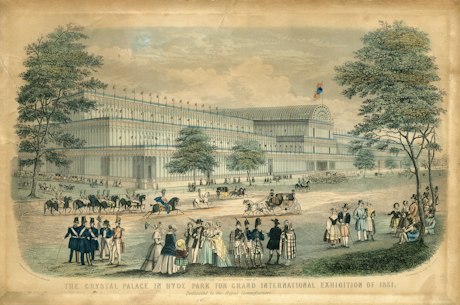
That idea would eventually expand beyond a single nation. By 1851, London would invite the world to exhibit inside the Crystal Palace.
The trade fair had become the industrial exhibition. The next step was the Great Exhibition.
Bibliothèque nationale de France / Wikimedia Commons: 1798 exhibition manuscript collection
Wikimedia Commons: Exposition des produits de l'industrie française
History of Information: The First Official National Industrial Exposition Occurs in Paris
The 1798 exposition is commonly treated as the first official French national industrial exhibition and a precursor to the larger French industrial exhibitions and later international exhibitions. The surviving 1798 manuscript scans used here come from the Bibliothèque nationale de France and are marked public domain on Wikimedia Commons.
The Crystal Palace turns exhibiting into a global spectacle.
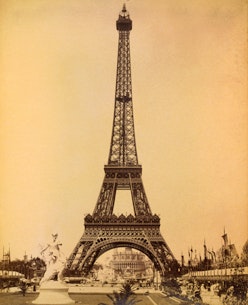
Explore the Great ExhibitionArchitecture itself becomes part of the exhibition experience.
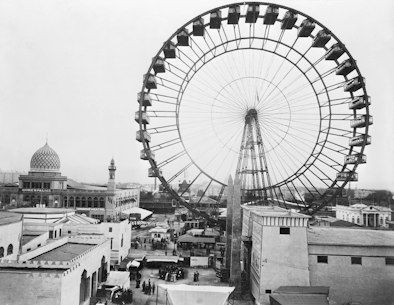
Explore the 1889 Paris ExpositionChicago combines industry, spectacle and visitor entertainment.
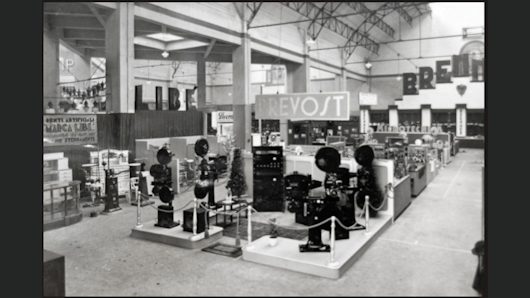
Explore the 1893 Chicago fairBrands turn exhibition spaces into coordinated visual environments.
Explore exhibition brandingReusable systems make exhibition stands faster to build.
Explore modular exhibition standsPortable hardware makes professional displays easier to travel with.
Explore portable displays