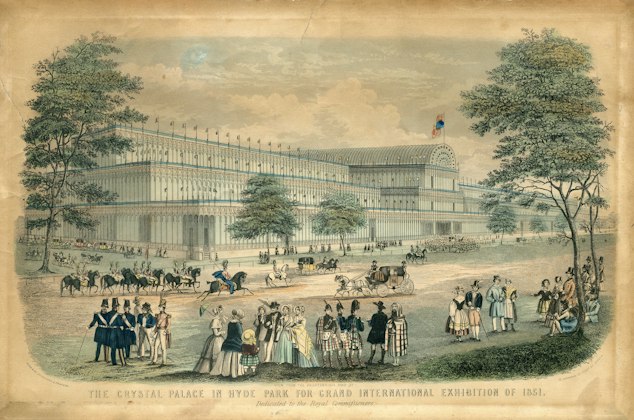
The Crystal Palace in Hyde Park for the Great Exhibition of 1851

1851: The Great Exhibition

A History of Trade Shows

In 1851, London turned industrial display into a global spectacle. Nearly 14,000 exhibitors and more than six million visits made the Great Exhibition a defining moment in the history of exhibitions.

The exhibition goes global

The Great Exhibition of the Works of Industry of All Nations opened in Hyde Park on 1 May 1851. It was conceived as an international showcase of industry, manufacturing, design and invention.

The Victoria and Albert Museum records more than 100,000 objects, lent by 13,937 exhibitors, representing 34 foreign nations as well as more than 30 territories of the British Empire. Over the five-and-a-half-month run, more than six million visits were recorded.

This was no longer a national industrial showcase. The exhibition had become global.

Read the V&A's history of the Great Exhibition

Inside the Crystal Palace

The Crystal Palace was an exhibition system in its own right

Paxton's building is important not just because it looked extraordinary, but because of how it was made. The V&A describes a rapid construction process based on standardised prefabricated parts, with iron columns, girders and enormous quantities of glass assembled in only a few months.

That modular logic feels surprisingly modern. Exhibition systems today are designed to be assembled, adapted and reused efficiently. The Crystal Palace applied the same broad principle at architectural scale: standard components creating a huge temporary environment.

The building was so distinctive that it quickly acquired the nickname 'Crystal Palace', and the architecture became inseparable from the identity of the event.

Organisation becomes part of display design

With more than 100,000 objects to show, organisers needed a clear system. The exhibition was divided into four broad groups: Raw Materials and Produce, Machinery and Mechanical Inventions, Manufactures, and Fine Art.

Britain and its territories occupied the western side of the building, while foreign nations were allocated space in the east. Visitors could therefore navigate not just individual exhibits, but whole categories and national sections.

This is another important step towards modern exhibitions: zoning, categories, floor planning and visitor flow become part of the display strategy.

An exhibition is no longer just a collection of exhibitors. It is an organised experience.

Exhibitors competed for more than sales

The Great Exhibition formalised another feature that remains familiar today: prestige. Exhibitors could receive medals recognising excellence in production, workmanship and innovation.

The V&A records several classes of awards, including Council Medals, Prize Medals, Exhibitor's Medals and Juror's Medals. Recognition at the exhibition could strengthen a manufacturer's reputation far beyond the event itself.

That changes the commercial value of exhibiting. A company is not simply showing a product to someone who may buy it. It is also building credibility, reputation and status in front of competitors, journalists, buyers and the public.

Modern exhibitors would recognise that immediately.

Why 1851 matters to exhibition history

By 1851, almost every major element of the modern exhibition model is visible:

  • A purpose-built exhibition venue

  • Thousands of exhibitors

  • International participation

  • Categorised floor space

  • Large-scale product displays

  • Public demonstrations of technology and innovation

  • Awards and recognition

  • Millions of visitors

  • A temporary event with long-term commercial and cultural impact

The Great Exhibition was more than a large fair. It helped establish the international exhibition as a format in its own right.

Imagine CES... but powered by steam.

Sources & further reading

Historical note

The V&A gives a total of 13,937 exhibitors and more than six million visits. Contemporary parliamentary discussion sometimes rounded the exhibitor figure to 15,000, so this page uses the V&A's more precise retrospective total. The exhibition ran from 1 May to 11 October 1851.

Explore More History