 Trustpilot - Rated Excellent
 In-house Design & Print
 Express Production Options
 Instant Credit for Businesses
  Newsletter
Marketing trends come and go. New technologies emerge, consumer behaviours evolve, and businesses constantly search for the next breakthrough tactic that will capture attention and drive sales. Yet despite all this change, some marketing principles remain remarkably effective. One of the most enduring is eye-level marketing.
The concept is simple: people are naturally drawn to information, products, and visual stimuli that sit directly within their line of sight. Whether in a retail environment, a shopping centre, an exhibition hall, or a corporate setting, what customers see first often influences what they engage with most.
While digital advertising and online marketing dominate many discussions about customer engagement, physical visibility continues to play a significant role in purchasing decisions. Eye-level positioning remains one of the most reliable ways to attract attention, communicate key messages, and influence behaviour.
Understanding why eye-level marketing works can help businesses make smarter decisions about signage, displays, product placement, and event marketing, ultimately leading to stronger engagement and better results.
What Is Eye-Level Marketing?
Eye-level marketing refers to the strategic placement of products, promotional materials, or messaging within a customer's natural field of vision.
The idea is rooted in human behaviour. People tend to scan environments quickly rather than examine every detail. As a result, items positioned directly ahead are far more likely to be noticed than those placed above, below, or outside typical sightlines.
Retailers have used this principle for decades. Premium products are often placed on shelves at eye level because they receive more attention and generate higher sales than products positioned elsewhere.
However, eye-level marketing extends far beyond retail shelving. It applies to:
Retail signage
Promotional displays
Exhibition stands
Window graphics
Point-of-sale materials
Information boards
Event branding
Wherever businesses compete for attention, visibility matters.
The Psychology Behind Eye-Level Visibility
To understand why eye-level marketing remains effective, it helps to examine how people process visual information.
Humans are naturally wired to seek efficiency. When entering a new environment, the brain rapidly filters information and focuses on elements that appear most relevant or easiest to process.
Objects placed directly within the line of sight require less effort to notice.
This creates several advantages:
Faster recognition
Improved message retention
Increased engagement
Reduced cognitive effort
Higher likelihood of action
People often assume they make entirely rational decisions, but much of our attention is guided by subconscious processes. Eye-level placement takes advantage of these natural tendencies.
Instead of asking customers to search for information, it presents information exactly where they are already looking.
Why Customers Often Miss Poorly Positioned Marketing
Many marketing materials fail not because the message is weak, but because the audience never sees it.
Businesses frequently invest heavily in design, printing, and branding while overlooking placement. A beautifully designed display can become ineffective if it sits outside the customer's natural viewing area.
Common positioning mistakes include:
Hanging signage too high
Placing displays below waist level
Blocking visibility with furniture or products
Positioning key messaging away from customer flow
In busy environments, customers are unlikely to adjust their behaviour to seek out information. Instead, they engage with what is easiest to see.
Eye-level marketing removes barriers between the message and the audience.
Eye-Level Marketing in Retail Environments
Retail spaces provide some of the clearest examples of eye-level marketing in action.
Research and industry experience consistently show that products placed at eye level outperform those positioned elsewhere. This is particularly true for impulse purchases and promotional items.
Customers walking through stores are exposed to thousands of visual stimuli. They rarely analyse every shelf individually. Instead, they focus on what appears directly ahead.
This is why retailers often reserve eye-level space for:
High-margin products
New launches
Promotional offers
Best-selling items
Seasonal campaigns
The principle remains effective because consumer behaviour has not fundamentally changed. Attention is still limited, and visibility still influences decision-making.
The Impact of Eye-Level Signage
The same principles apply to signage.
Whether promoting a sale, directing customer movement, or communicating brand messaging, signs perform best when they can be seen quickly and effortlessly.
Eye-level signage offers several benefits:
Improved Readability
Messages positioned within natural sightlines are easier to read without requiring customers to stop or change direction.
Greater Attention
Customers are more likely to notice signage that appears directly ahead compared to signs positioned above or below their field of vision.
Better Message Retention
Information that is seen clearly and processed easily tends to be remembered more effectively.
Increased Action
When customers notice and understand a message quickly, they are more likely to respond to it.
The effectiveness of signage is often determined as much by placement as by design.
Why Eye-Level Marketing Matters at Events
Trade shows and exhibitions are highly competitive environments.
Visitors are surrounded by competing stands, promotional materials, demonstrations, and branding. Every exhibitor is fighting for the same limited resource: attention.
In these environments, visibility becomes even more important.
Exhibitors who understand the importance of maximizing visibility at events and exhibitions often focus heavily on sightlines, visitor flow, and display positioning rather than simply increasing the amount of information on display.
A message positioned where attendees naturally look has a much greater chance of generating engagement than one that requires effort to locate.
This is particularly important during busy events where visitors are making rapid decisions about which stands deserve their time.
Eye-Level Marketing and Decision-Making



Attention is the first step in every purchasing journey.
Before customers can consider an offer, evaluate a product, or engage with a brand, they must first notice it.
Eye-level placement helps influence several stages of the decision-making process:
Awareness
Customers become aware of products, promotions, or messaging more quickly.
Consideration
Visible products receive more evaluation and engagement.
Preference
Items that receive greater attention often become more familiar, which can positively influence perception.
Action
Increased visibility frequently leads to higher interaction and conversion rates.
The relationship between visibility and behaviour is one of the reasons eye-level marketing remains relevant across industries.
Balancing Visibility with Design
Placement alone is not enough.
A display positioned perfectly at eye level can still underperform if the design itself fails to communicate effectively.
Successful eye-level marketing combines:
Strategic placement
Clear messaging
Strong typography
Effective colour contrast
Appropriate visual hierarchy
The goal is to create a display that attracts attention and communicates value immediately.
Once attention has been earned, design determines whether engagement continues.
Applying Eye-Level Principles to Exhibition Displays
Exhibition displays benefit enormously from eye-level thinking.
Visitors often spend only a few seconds deciding whether to approach a stand. During that brief window, the most important information should be positioned where it can be seen instantly.
This typically includes:
Brand name
Core value proposition
Key visual imagery
Calls to action
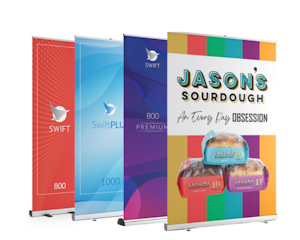
Many exhibitors also utilise roller banners for trade shows and exhibitions because they naturally position branding and messaging within typical viewing ranges, making them effective tools for communicating information quickly.
The key is ensuring that the most important content sits where visitors are most likely to notice it first.
Common Eye-Level Marketing Mistakes
Even businesses familiar with the concept can make mistakes that reduce effectiveness.
Prioritising Decoration Over Communication
Visual impact is important, but messaging must remain clear and accessible.
Positioning Secondary Information Too Prominently
Customers should see the most important message first, not supporting details.
Ignoring Customer Movement Patterns
Displays should align with how people naturally move through a space.
Overcrowding Visual Areas
Too much information at eye level can create confusion rather than engagement.
Assuming More Signage Equals More Visibility
Strategic placement often delivers better results than increasing the number of displays.
Avoiding these mistakes helps ensure that visibility translates into meaningful engagement.
Why Eye-Level Marketing Continues to Work in a Digital Age
Some marketers assume that physical visibility matters less because consumers spend so much time online.
In reality, the opposite is often true.
Modern audiences experience unprecedented levels of information overload. They are constantly filtering messages, advertisements, notifications, and content.
This makes immediate visibility even more valuable.
Eye-level marketing works because it aligns with how people naturally consume information. It reduces effort, improves clarity, and helps messages stand out in crowded environments.
Technology may change, but human attention remains limited.
Businesses that understand how attention works continue to benefit from principles that have remained effective for decades.
Putting Your Message Where Customers Are Already Looking
Eye-level marketing remains effective because it works with human behaviour rather than against it. People naturally notice and engage with information that appears directly within their line of sight, making visibility one of the most powerful tools available to marketers.
Whether in retail environments, exhibitions, showrooms, or public spaces, positioning plays a critical role in determining whether a message is noticed or ignored.
Businesses often focus heavily on design, content, and branding, but these elements can only deliver results if customers actually see them. By understanding how attention works and applying eye-level principles strategically, organisations can improve engagement, strengthen communication, and increase the effectiveness of their marketing efforts.
In a world filled with distractions, earning attention remains the first step towards influencing customer decisions - and eye-level marketing continues to be one of the simplest and most effective ways to achieve it.
posted in Marketing Advice
Published: | Updated:


Written By:
Peter Symonds
Peter Symonds is Managing Director at Display Wizard, a Preston based display and exhibition stand provider.
He has over 15 years of experience in the large format print and exhibition industry and has helped grow Display Wizard into one of the UK's leading provider of high-quality display solutions.
Share this Event