 Trustpilot - Rated Excellent
 In-house Design & Print
 Express Production Options
 Instant Credit for Businesses
  Newsletter
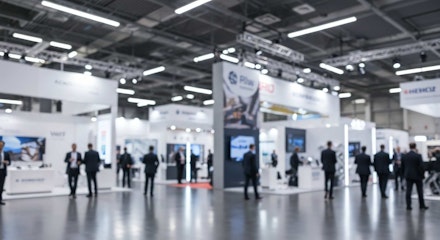
When it comes to trade shows, you need to think of your stand not as a display surface, but as a spatial environment that shapes how visitors move, where they look, how long they stay, and whether they engage with your team. Most exhibitors think about what their stand communicates visually; fewer think deliberately about what it communicates spatially. The ones who do tend to have noticeably better results.
The psychology of how people move through and respond to physical spaces is well-documented, and the principles apply directly to trade show booth design.
How Does Booth Layout Influence Whether Visitors Stop?
The decision to enter a stand or slow down at one is made in a fraction of a second and is driven primarily by what the visitor perceives from the aisle. Open layouts - those without physical barriers at the front - are entered more readily than closed ones. This sounds obvious, but the number of stands at any given trade show with a table, counter, or product display blocking the entrance suggests it isn't treated as an obvious principle in practice.
An open front communicates accessibility and confidence. A barrier, even a low one, communicates defensiveness and requires the visitor to make a conscious decision to cross it. Many won't bother, particularly in the first hour of the show when they have many stands still to see and limited reason to commit.
The visual depth of a stand also matters. A layout that draws the eye inward - a focal point at the back of the space, a clear pathway through - creates curiosity and pulls visitors in. A layout that presents everything immediately at the front leaves nowhere for the visitor's attention to travel.
What Layout Shapes Work Best At Trade Shows?
The options available to most exhibitors are constrained by their allocated space and configuration, but within those constraints there are meaningful choices.
Inline stands - the most common configuration, with neighbouring stands on each side and visitor access from the front only - benefit most from strong depth and clear visual hierarchy: something compelling at eye level immediately, something interesting deeper in the space, and a clear path to reach it.
Corner stands offer two open faces and a natural flow for visitors approaching from either direction. The layout challenge is creating a coherent experience for visitors entering from both angles rather than designing for one and treating the other as secondary.
Island stands, open on all four sides, require display elements that communicate clearly from every direction. A design that works as a single front-facing backdrop fails in an island configuration because a significant proportion of visitors will approach from behind or the sides.
How Does Sight Line Management Affect Dwell Time?


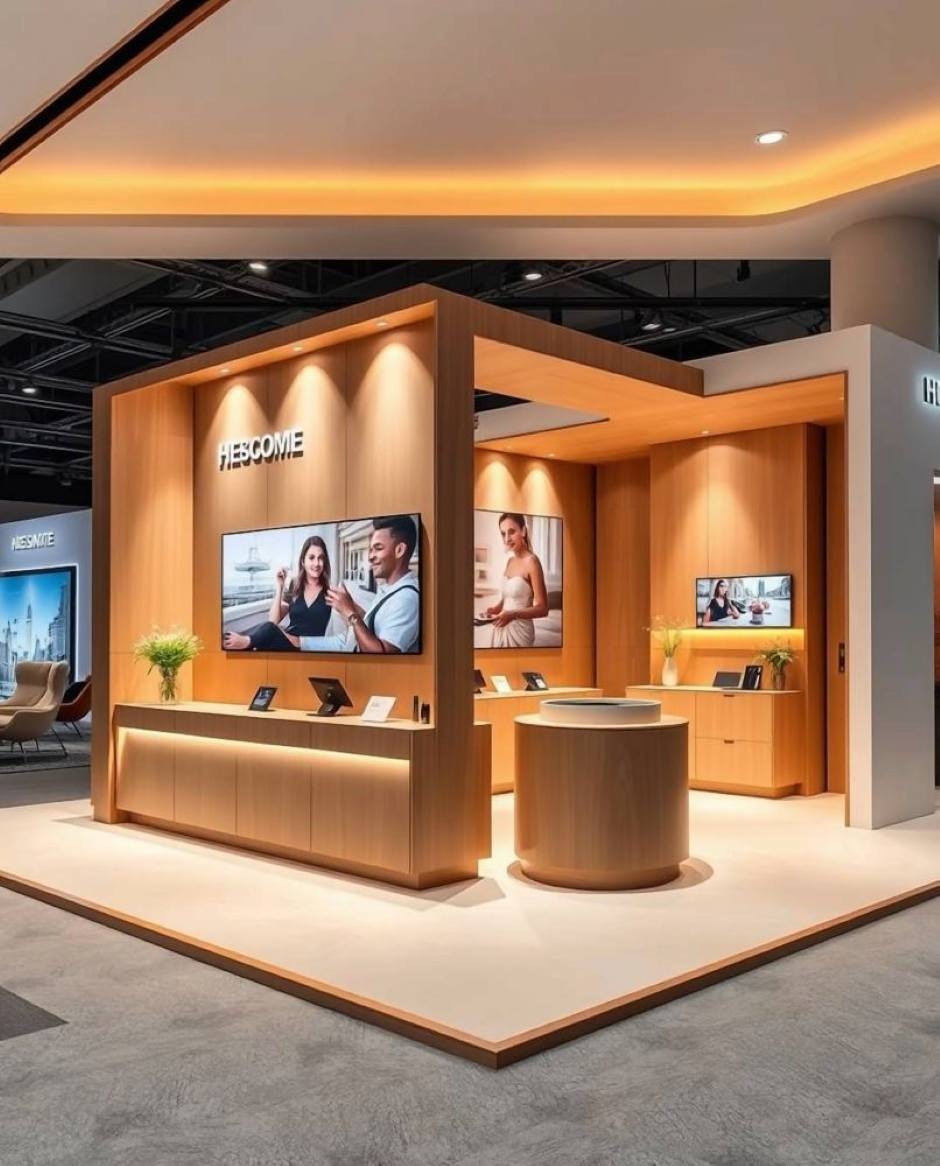
Dwell time - how long a visitor stays at your stand - is one of the most important and least-measured metrics in exhibition marketing. A visitor who stays for three minutes has a fundamentally different experience from one who pauses for thirty seconds, and the conversion rate from longer dwell times is substantially higher.
Sight lines are one of the primary levers. A layout that reveals information progressively - where moving deeper into the stand reveals something new rather than just a closer view of what was visible from the aisle - gives visitors a reason to keep moving rather than forming a complete impression from the periphery and moving on.
Display height variation also extends dwell time. A layout that uses only standing-height displays creates a single visual plane. Combining tall backdrop elements, mid-height product or literature displays, and table-level items creates a more complex visual environment that takes longer to process and engages the eye more actively.
Does Clutter Actually Harm Engagement?
Significantly. The research on environmental psychology is consistent on this point: cluttered environments increase cognitive load, reduce the sense of control, and produce lower engagement and more negative emotional responses. At a trade show stand, this translates directly to visitors who feel overwhelmed, spend less time, and leave with a hazier impression of your brand.
This is why minimising booth clutter to guide visitor behaviour is not an aesthetic preference but rather a functional one. Negative space in your layout is not wasted space; it's the breathing room that makes the elements you've chosen to include more impactful.
One product, presented well and with clear context, outperforms ten products competing for attention in a confined space. This is a difficult editorial decision for exhibitors who have broad ranges, but it's the right one.
How Does Lighting Factor Into Layout Decisions?
Lighting is where exhibition stand design most commonly fails to reach its potential. Standard exhibition hall lighting is typically flat, harsh, and uniform - designed for visibility rather than presentation. A stand that relies entirely on ambient hall lighting looks identical to every other stand in terms of illumination, which means it misses an opportunity to differentiate through atmosphere and focus.
Adding lighting to your layout - whether through lit backdrops, spotlights on key elements, or illuminated display options that provide their own even, high-quality light source - changes the visual priority of your stand from the aisle. Lit elements attract the eye instinctively, which means a well-lit stand draws attention in a way that relies on basic human visual processing rather than hoping the visitor happens to look in the right direction.
Work With Display Wizard
Display Wizard's range covers everything from portable banner stands and pop-up displays to modular systems and LED lightboxes, all produced in-house on high-definition EFI printers with a graphic design team that understands how displays need to work in real exhibition environments. With over twenty years of experience and a client list that includes the BBC, Bank of England, and Mercedes-Benz, the product knowledge behind what you're buying is genuine.
Explore the full range at Display Wizard and build a layout that works harder than the stands around it.
posted in Buyer's Guides
Published: | Updated:


Written By:
Peter Symonds
Peter Symonds is Managing Director at Display Wizard, a Preston based display and exhibition stand provider.
He has over 15 years of experience in the large format print and exhibition industry and has helped grow Display Wizard into one of the UK's leading provider of high-quality display solutions.
Share this Event